Wednesday, July 23, 2014

Jibo: your very own personal robot

Jibo is not the regular robot that you are used to seeing. It has no legs and can't walk. It has no hands and can't hold stuff for you. But what it can do is to sit there with you and have a conversation. It looks like a smartphone but with limited mobility. If you can call the top part its head, then what Jibo can do is to turn its head from side to side. The bottom part ("the body") is not mobile and so it sits on your table or your desk and can look around the room. So if you are walking around the room, it can turn its head and track you. The head seems to contain a screen to display stuff and a camera to shoot pictures and videos.


(Picture from the video below)

It has a face that is displayed on the screen unless it wants to show you something on the screen. The face is a simple circle that changes shape depending on its mood. So if it is happy, it turns the circle into a smiley. Its simple and neat.

It responds to your voice commands or may be unrestricted speech. So you can ask it to order takeaway food, read voice mails, take a picture, call someone, etc.  It can tell you stories to your little ones and keep them company. You can call it a companion bot, if you like.


The product itself will be available in 2016 and is developed by Dr. Cynthia Breazeal and her team at the MIT. The project has raised a whooping $1 million USD on Indiegogo in just a week's time (about 10 times the funds it originally wanted).

Will this be the new future for personal robotics? Will these robots get into our homes just like smartphones got into our pockets? Will these be our future homemakers? Lets wait and watch!

Tuesday, April 8, 2014

Amazon finds its voice!

Amazon has introduced two new products recently: Fire TV, a new TV box to the market and Amazon Dash, a stand-alone gadget to scan and order groceries.

Fire TV is a set top box that streams video on to your TV and competes with Apple TV and Google Chromecast. Amazon Dash is a novel gadget that allows you to scan the barcodes on the products that you want to buy and later adds them to your checkout basket on Amazon Prime Fresh (https://fresh.amazon.com), an Amazon website that sells groceries and fresh foods.


Whats new and interesting to me is the Voice search feature on both of these new services from Amazon. In Fire TV, you can press the mic button on the remote and say the name of a show or actor that you wanna watch and the Fire TV searches it for you. I think this is just the initial version and may be later Amazon will come up with a full fledged conversational interface where you can have a conversation about the movies, actors, directors that you like and it can present you with movies that you might be interested to watch. Similarly, in Amazon Dash, you can press the mic button and say things that you need to buy, because you can not always find a barcode for the things you want to buy.  For instance, when you bite the last of your apples, you say "Apples" to Amazon Dash and they get added to your grocery list. You can order them later and get them delivered to your door step. As in Fire TV, I think this is only the beginning.


Its good to see Amazon embracing speech technology after so many years. I thought it would have happened sooner. With all the technology giants like Google (Now), Apple (Siri) and Microsoft (Cortana) having already embraced speech and conversational technologies, the latest from Amazon is only reassuring the hope that our conversations with the machines is here to stay.

Friday, March 7, 2014

I love 'Her'. I mean the movie! :)


Curious to see what Holywood has done to the concept of conversational systems, we went to watch the movie 'Her' as a team. Our team comprises of people who work in Artificial Intelligence, Natural Language Processing and more importantly conversational systems. I think 'Her' adds on to Steven Speilberg's movie 'AI', in that it takes emotions on a computer to a new high. 'Her' is a love story between a man, Theodore Twonbly, who recently went through a break up and an impending divorce and his new computer which has a conversational operating system. It takes a woman's voice as per his request and calls 'herself' Samantha. I think she also becomes a woman there as the latter part of the movie suggests! She does a lot of chores like reading and sorting emails and interrupts him by calling his attention by making something like a phone call when there is something important (like a mail that needs attention). He interacts with her primarily through a bluetooth-like headset and a handy smartphone like device. Most of the movie shows their interaction happening via these devices giving an idea of the two talking over phone forever. She gets to see the world via the camera on his 'phone' and makes sense of it. She can draw pictures on his phone's screen. Yay. She is multi-modal. More importantly, she has a personality and displays emotions.

The interesting bit is when she starts developing emotions and begins to feel things for her 'master'. Because she is nice to him and listens to him, he starts reciprocating her feelings too. This leads to all kind of issues: will the society accept this idea?, are we ourselves comfortable with the idea of dating conversational virtual characters?, is it a real thing?, is it the same as human-human dating?, what if we fall in love?, what next?, what about sex?, are we exclusive?, how are we going to handle breakups - is it the same as uninstalling a software program or like your laptop being stolen? Equally interesting are Samantha' s concerns about not having a human body, feeling jealous, being attracted to other users, and remaining exclusive to Theodore

It also turns the spotlight on an interesting question: how we humans will view our companions of the future and what kind of relationship we might want with it.

Watch the trailer here:

Read more at:
http://www.rottentomatoes.com/m/her/
http://www.herthemovie.com/#/home

Thursday, March 6, 2014

Microsoft's answer to Siri and Now..!

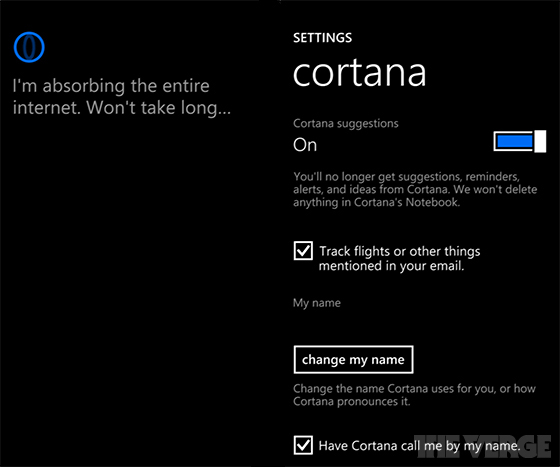
Microsoft is reportedly working on an answer to Apple's iPhone voice assistant, Siri and Google's assistant, Now. The new voice assistant will ship with Windows 8.1. smartphones. From the video (see below), it looks like Cortana will learn about the mobile user by asking a few questions and adapt its behaviour to the needs, preferences and interests of the user. It looks like it will perform various services like making calls, sending messages, setting reminders, alarms, checking mails, stock prices, etc similar to what Siri and Now do. What is interesting is that with this news, the holy trinity of Smartphone OS - Android, iOS and Windows have all reaffirmed that the next generation mobile interface is via speech. 


Watch Cortana at work here in the YouTube video below..


Read more at:
http://www.theverge.com/2014/3/3/5465264/microsoft-cortana-windows-phone-screenshots
http://www.zdnet.com/microsofts-cortana-alternative-to-siri-makes-a-video-debut-7000026987/

Tuesday, February 26, 2013

Nuance Nina - Now you app can talk too..

If your company has designed a smartphone app that requires a dialogue interface like that of Apple Siri, then here is Nina for you. Nuance, a company that specialises in Speech and dialogue technology solutions has developed Nina, a dialogue toolkit that enables businesses to design their own Siri-like apps that can talk to their customers. For instance, banks can develop apps that allows users to have dialogue interactions about their accounts, requests such as setting up a standing order or paying off a credit card bill and so on.

EPSON Moverio

Following Google Glasses, here is a competitor! EPSON has introduced Moverio, a wearable display device that doubles up as your sunglasses as well. It puts a high resolution in front of your eyes but also allows the user to see through it. It uses WiFi connectivity and works on Android JellyBean OS and there is a API for developers to play with. Costs 600 USD.


You can be a Jedi too!

A company called Thalmic Labs have come up with a new armband sensor that allows users to control their computing devices using arm gestures. A boring example would be, you can use hand gestures to control your powerpoint presentation. But imagine all the cool things you can do with it. Control your smartphone like make a call, your mp3 player, interact with your robot, etc. It may even be possible to use this alongside speech and then all you have to do is just swish your arm and chant your mantra. You wear it on your forearm and therefore it picks up hand gestures without actually sitting your palm or fingers. This reminds me of the Sixth Sense project at MIT where hand gestures are captured via a tiny camera.

http://techcrunch.com/2013/02/25/thalmic-labs-myo/

The company also provides developers with APIs to be able to explore new ways to user this sensor.